When Tree Felling with Crane Becomes the Safest Option
I have been working as an arborist in Cape Town for over fifteen years, and I still remember the first time a homeowner watched me rig a large pine down piece by piece and asked why I did not just drop the whole thing in one go. The answer, as with so much in tree work, comes down to physics and surroundings. In a dense urban environment like Kenilworth or Clifton, a tree that leans over a house, a garage, or a set of electric utility lines cannot simply be felled with a chainsaw in the conventional sense. That is where tree felling with crane enters the picture. It is not the first method we reach for, but when the situation demands it, nothing else compares for safety and precision.
The basic idea is straightforward: a crane lifts the tree or heavy sections of it away from the work area, eliminating the need for a traditional fall zone. Instead of calculating the exact hinge and hoping the wind stays calm, we use the crane to take the weight off the cut, then lower each piece to the ground where it can be processed safely. This approach shines in tight spots where a mistake could mean structural damage or, worse, injury. I have seen crews spend an entire morning setting up a crane truck on a narrow street, blocking off traffic, and rigging a single large oak that overhung two properties. By midday, the tree was gone, and the only sign of the work was a pile of sawdust and a happy client.
What sets tree felling with crane apart from standard crane-assisted removal is the level of coordination required. The crane operator, the arborist in the tree, and the ground crew must work in perfect sync. Every lift is planned beforehand. The arborist climbs into the canopy wearing a full safety harness and assesses the weight distribution of each limb. They tie off rigging lines at carefully chosen points, often using a load cell to measure the exact tension before the cut. A chainsaw is not just a cutting tool here; it is a precision instrument. One wrong cut and the load can shift unexpectedly, pinching the blade or causing the limb to swing into an obstacle. Pinching is a real hazard in this kind of work, especially with dense tree species like oak or gum, and it requires a calm head and a sharp chain to get out of.
The crane itself is not just a simple hook-and-lift device. It comes with its own set of considerations. The crane truck must be positioned on stable ground with outriggers extended. The boom angle and radius have to account for overhead wires, building eaves, and the tree's own branches. The crane operator needs a clear view of the arborist's hand signals, and radio communication is standard on every job. I have worked on sites where the only way to reach the back of a property was to boom the crane over a roof, with just centimetres of clearance on either side. That kind of job does not leave room for guesswork.
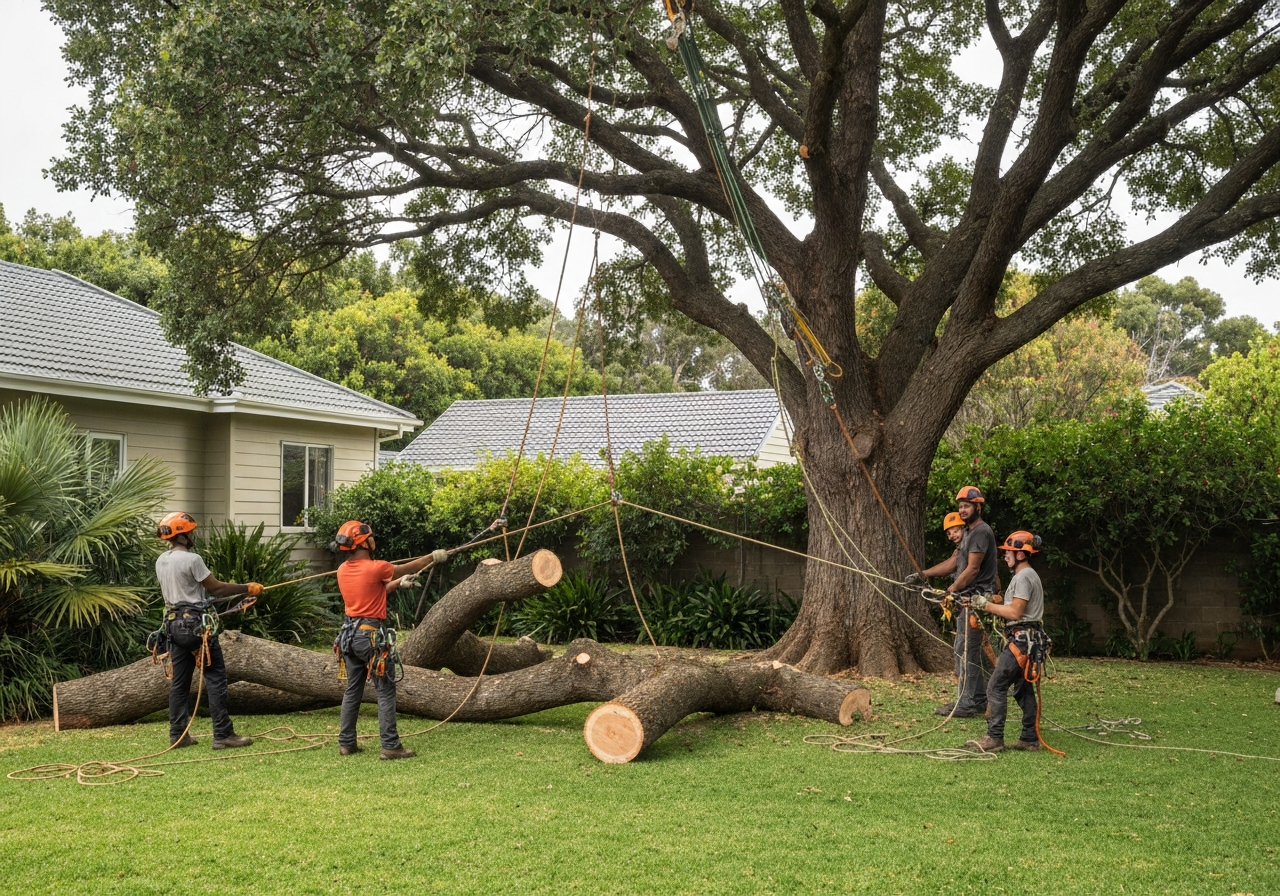
One of the biggest advantages of tree felling with crane is the reduction in site damage. In a conventional removal, the ground crew clears a large drop zone, and the tree comes down in sections that can still gouge the lawn or crush a fence. With a crane, each piece is lowered vertically and placed exactly where the ground crew wants it. The result is a much cleaner site, less repair work afterwards, and happier neighbours. A good crew will also bring a stump grinder to remove the base and a wood chipper for the branches, leaving the garden in better shape than they found it. That kind of full cleanup is what separates a professional operation from a weekend job.
Another scenario where crane work becomes essential is emergency tree service. After a storm, a tree may be partially uprooted or hung up in another tree, with tension stored in the wood. Trying to cut that with a chainsaw from the ground is extremely dangerous. The crane allows the arborist to lift the tree off its point of failure, relieving the tension in a controlled way. I once responded to a call in Kenilworth where a large blue gum had split down the middle and was leaning on a neighbour's roof. The home owner was understandably worried. We brought in a crane, rigged the two halves separately, and lifted them away without the roof even creaking. The tree removal took less than an hour once the crane was set up. Without it, we would have been looking at a complex rigging job that would have taken all day and still carried more risk.
Of course, tree felling with crane is not the cheapest option. It involves mobilising a crane truck, paying a certified crane operator, and often closing part of the street. That is why we always start with an on-site quote. The price depends on the tree's size, its species, how accessible it is, and whether there are obstacles like electric utility lines or structures in the way. Sometimes a skilled arborist can rig a tree down in small pieces without a crane, and that is perfectly fine. But when the tree is too large, too dangerous, or too close to buildings, the crane becomes the tool that makes the job possible. It is an investment in safety and peace of mind.
I have also seen the crane used in reverse, to place new trees or large feature plants, but that is a different story. For removal, the key is that the crane gives you control over the fall. Gravity is not the boss. You are. And that control translates directly into safety for the crew and protection for the property. Every arborist I know has a story about a job that could have gone wrong if they had tried to fell conventionally. Most of those stories end with a crane saving the day.
If you are in Cape Town and considering tree removal, especially for a large specimen near your home, it is worth asking about crane-assisted methods. A professional company will assess the site, explain the options, and give you a clear breakdown of costs. They will also handle the permits if needed, because working near public roads or power lines requires coordination with the municipality and the utility provider. A good emergency tree service will have a relationship with a local crane company so that they can respond quickly when a storm hits.
At the end of the day, tree felling with crane is a specialised skill that combines the knowledge of an arborist with the mechanical capability of a crane. It is not the first tool in the box, but it is often the best one for the job. When you see a crane truck parked outside a house in Clifton or Kenilworth, you know that someone is getting a thorough, professional job done. And as a homeowner, that is exactly what you want.